
Before you read our thoughts, click here to read the poem in full if you haven’t already!
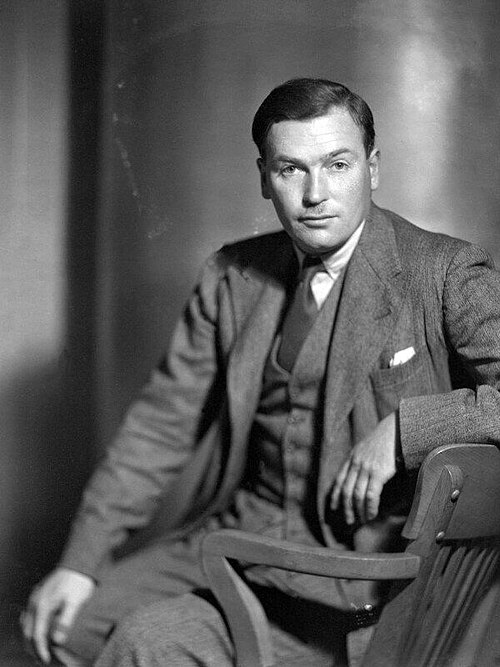
Richard Aldington stands amongst the quiet voices of the First World War poets, alongside the likes of Siegfried Sassoon and Wilfred Owen. Before the war broke out, he was a prominent figure in the Imagist movement, capturing moments of pure and unfiltered beauty in his writings. However, the time he spent serving on the Western Front changed his mind and his writing style forever.
What is so wonderful about Field Manoeuvres is that it is written just on the cusp of the war, and therefore it serves as an almost farewell to that dreaming, Imagist self that Aldington once was. It is written as if the narrator knows he will be changed by the violence to come, and so he is taking a minute to feel the sun on this skin one final time.
The long autumn grass beneath my body
Soaks my clothes in dew;
Where my knees press into the ground
I can feel the damp earth.
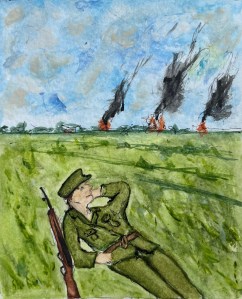
The poem paints the picture of a solitary man, laying outstretched on the grass beside his abandoned, forgotten rifle. The grass is damp and the smell it produces from being crushed between his body and the earth weaves its way deep into his nostrils. He should be training, he knows that, but instead he just lays there and allows his spirit to drift up into the clouds. For this short moment, the immense beauty of nature overpowers the destruction of war ahead and the man allows himself to pause to admire it.
There is no sound;
The wind hisses gently through the pine-needles;
In this stillness, this silence, he ignores his orders and the violence he should be partaking in, he abandons this all to the transcendent beauty of nature and in this sense, there is an almost guilty joy in being alive. A guilt of laying on damp grass, of hearing the wind and living in peace simultaneously to war. And it is the intermittent military language riddled throughout this poem which reminds us of this.
Interminable squadrons of silver and grey horses
Pace in long ranks the blank fields of heaven.
This language cuts through his daydream and stifles the traditional pastoral calm of Imagist poetry, reminding us that the man’s life is bound to violence in the short days ahead. His choices will soon no longer be his own, and so perhaps this – to lay in the grass and look up at the sky – is the last decision which is truly his.
My spirit follows the gliding clouds
And my lips murmur of the mother of beauty
Standing breast-high in golden broom
Among the English pine-woods!
We are left with this final image of the soldier’s spirit, his soul, being cast away to glide amongst the clouds while his body remains tethered to earth and to destruction and to duty. When Aldington returned from war, he was shellshocked, part of himself was lost on those battlefields and he was never quite the same again. But he won’t let this happen to this imagined soldier. No, here he sends off this young man’s spirit to live eternally uncorrupted by the horrors of war within the beauty of the clouds, far, far out of reach of the brutality to come.
And so, for this poor, doomed soldier, this pause is his perhaps his first act of resistance and his final act of freedom, and who could fault him for that?
The Ploughman’s Community Comments
Robert, Texas: The image of his “obsolete rifle” is so significant to me. He not only stops doing his task, but completely abandons his weapon to admire the transcendent beauty of nature.
Katrina, Ireland: “The flutter of a finch’s wings above my head”. The alliteration of the repeated ‘f’ sound almost mimics the sound of a plane flying in the wind. He describes a simple part of nature as something man-made, as machinery. It’s like this man’s view of the world is slowly being corrupted by the war – even with the image of a bird flying above his head he is incapable of describing it in anyway other than with militaristic language.
Doug, Nottinghamshire: To me, the proximity of war and death is what makes this mans admiration of nature so powerful, and also so tragic.
 The Ploughman's
Leave a comment