
Hey! Check out this live performance to hear Jeff Mangum sing Two-Headed Boy live, and click here to read the lyrics -being familiar with the song will make this post make sense. Also, for the sake of this post, we will be referring to the song as a poem throughout and analysing the lyrics through the lens of literature.
The Ploughman’s Poetry Discussion, Two-Headed Boy
Two Headed Boy by Jeff Mangum stands out on the In An Aeroplane Over The Sea album, mainly for its grotesque descriptions of death, closely coupled and contrasted with deeply intimate images of human connection. While the whole album incorporates this style throughout, Two Headed Boy (Part One and Two) seems to surpass the others by doing it in such a powerful way, therefore so humanely encapsulating feelings surrounding loss.
The poem opens in a dark, seemingly hopeless place. The sun which once shone no longer does, and instead is replaced by an abyss of deep, deep darkness. There seems to be no pull of gravity or sense of dimension – it merely opens in a black, perhaps endless void, which is filled with floating shards of glass.
But then there is this tapping sound. It is only slight, and it is only quiet – but it is there and it can be heard. And this gentle tap we hear is being made by the mysterious “Two-Headed Boy” of which the poem is titled for. The black darkness brings forth a sense of hopelessness, whilst the sensory language creates an intimate atmosphere. It seems to be completely silent, except for the sounds of the Two-Headed Boy tapping on a jar, and the narrator vocalizing his search for him. The narrator is saying “I hear you. You are here, you exist. I know it is dark and lonely but I can hear you.” It is reassuring.
Then comes a sudden shift. We are propelled from this dark, eerie and highly atmospheric scene to a flashback of a joyous memory. Suddenly, life and light and movement are restored as we are placed within the scene of a boy wearing his best, dancing in a room filled with elegant music. He not only dances along as the music fills the room, but as it dives deep within his heart and compels this movement within his body.
The line at the end of this verse brings us back to the opening setting of the poem. It reminds us that this sweet memory is just that – a memory, which is being propelled through this eerie limbo that the once-dancing Two-Headed Boy now occupies.
And then comes the most astounding, intimate and raw description of human connection I may have ever heard:
“…in the dark
We will take off our clothes
And they’ll be placing fingers through the notches in your spine“
This is a simple image. It describes two people laying in bed, both facing the same way as the one of them is slowly and gently grazing their fingers through the notches of the other person’s spine. Nobody but Mangum would think to describe a scene of two people in bed in a way so intimate, so human and so damn real as this. The spine is a part of the body that doesn’t really hold any sexual – or even romantic – connotations, but if you really think of somebody counting the notches – 1, 2 ,3 – a deep sense of loving intimacy is abundantly clear. Furthermore, there is a sense of vulnerability behind this image as you can only feel somebody’s back if you are placed behind them. This vulnerability, paired with the tactile, bodily imagery is what makes Neutral Milk Hotel’s lyrics so powerful, and so human.
And then, in typical Jeff Mangum style, this deeply intimate and loving image is turned on its head with the shocking, grotesque description of this person’s dead eyes hanging loose in their sockets.
“Now your eyes ain’t moving now, they just lay there in their climb“
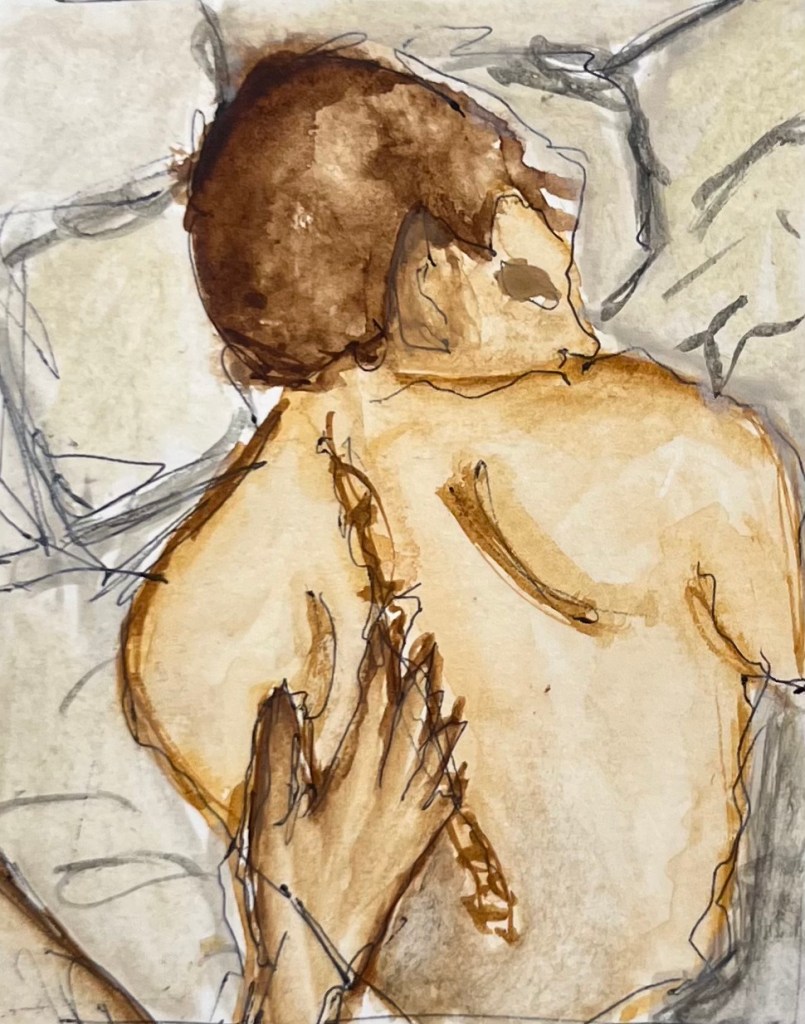
The bodily language used within this stark contrast masterly conveys the pain of losing somebody you were close to. We have just counted the notches in this person’s spine as they are cradled in our arms, and now we watch as their lifeless eyes lull in their sunken sockets and roll up in their climb towards death. They existed, and we felt them, and now they are gone. Often the eyes are understood as the window into somebody’s soul, but with this image it is clear that their soul is gone and the window is blocked.
A new verse begins and once again we are torn away from this image and propelled into another memory, almost as if this Two-Headed Boy’s life is flashing before him as he floats in his dark limbo. This memory portrays a more traditional story of love. It describes two people dancing under the light of the moon as one person sings to his lover. It is beautiful and rich, and what’s more – there is no performative quality to their love. He is singing only for her:
“Creating a radio play just for two
In the parlor with a moon across her face
And through the music he sweetly displays
Silver speakers that sparkle all day
Made for his lover”
And then, again, the beauty is replaced with a violent rupture as a horrific, grotesque image takes over. His lover, who he was just dancing with is now described as “choking with her hands across her face”. The intimacy is replaced with horror as the soft moonlight is replaced with her hands, placed on her face, suffocating and causing intense pain to her. And then, comes the chorus with the spine image again, and this cycle of intimacy and love being replaced with pain and suffering seems inescapable and unchangeable.
And finally, this whirlwind of a song, of life and death and pain and beauty and suffering and human connection comes to an end with a quiet acceptance of death, and letting go. The narrator is reassuring and tells the Two-headed Boy that “there’s no reason to grieve”. After revisiting these memories of life, he tells the boy to let go of everything he did in his life, and allow himself to rest.

“And I will take you and leave you alone
Watching spirals of white softly flow
Over your eyelids and all you did
Will wait until the point when you let go.”
The image of spirals of white resemble that of clouds, and perhaps symbolise everything that this boy was. All his hopes, dreams, ambitions and memories are now just spirals of clouds floating out above his body, ascending to the heavens as he himself sinks further into the ground in death. It is a whimsical image with a certain ethereal quality, which in turn portrays a beautiful acceptance and finality of death.
The lonely Two-headed Boy that we met at the beginning has been found in the darkness, and although is dead, has now escaped his limbo and is content in his peaceful death.
The Ploughman’s Community Comments:
Hugo, UK: I really like the way you highlight how the moonlight on her face has been replaced with her suffocating hands, I never really thought of this before!
Louis, Australia: What a song, incredible lyrics. Up there with Holland, 1945
Daisy, Wales: Jeff Mangum always excels in creating powerful images. They always stick with me, especially in this song. Wow.
Anonymous Reader: The entire album is a haunting love poem, but I love that you highlighted ‘Two-Headed Boy’ for this. “The lonely Two-headed Boy that we met at the beginning has been found in the darkness, and although is dead, has now escaped his limbo and is content in his peaceful death.”


 The Ploughman's
Leave a comment