
Before you read our thoughts, click here to read the poem or check out this video to hear Langston Hughes read The Weary Blues himself : )
The Ploughman’s Poetry Discussion – The Weary Blues.
Whenever I read The Weary Blues, there is something in my head that compels me to read it aloud, in the voice I imagine the musician to have. I don’t know if it is the steady, thumping rhythm of the poem, or the repeated breaks in the lines, but whatever it is, Langston Hughes manages to craft a soul so clear that I can hear him sing his blues within my head.
What makes this poem so great is the absence of the black man’s anger. Here he is, sat in some dingy room, deep within 1920s Harlem and amidst it’s Renaissance, not screaming nor crying, but merely singing his blues. It is a poem of genuine, deep-set exhaustion, of weariness consuming a man’s soul who then turns to find solace in his melancholy and blues.
“O Blues!
Swaying to and fro on his rickety stool
He played that sad raggy tune like a musical fool.
Sweet Blues!”
It is almost as if he is grasping for them, desperately trying to hold on to his blues, his identity and saying: ‘This is me. I know the blues. Oh Blues, I am tired and I am weary and I know you well.’ There is no anger present, no violence at all, just a tired, tired man at the end of his day vocalising his melancholy. It is weariness without rage.

The musician speaks once again:
“I got the Weary Blues
And I can’t be satisfied.”
He can’t be satisfied. It’s not that he won’t, it’s that he can’t. He sings to a mellow, quiet beat, almost like a nostalgia for a time that he never even had. Lit beneath the “dull pallor of an old gas light”, his melancholy becomes his companion, and his blues his Lord.
The lines which always seem to stand out the most comes within Langston’s description of the musician:
“With his ebony hands on each ivory key
He made that poor piano moan with melody.”
The piano too, a victim of his blues – moaning and wretched as it chimes its notes. Despite his talent, despite his clear, thoughtful mind, the physical descriptions of him do not go beyond the colour of his skin. By starkly contrasting his hands with the keys, Langston Hughes creates a quiet, aching metaphor of the racial divisions of the world that the man was born into.
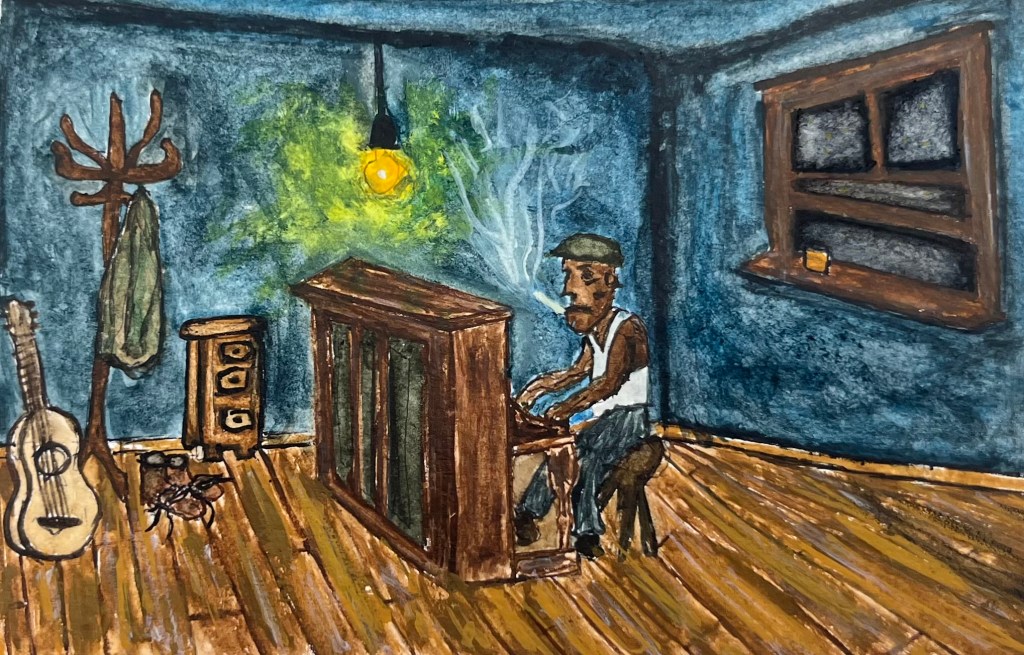
The piano – a symbol of European classical music and white high society becomes transformed as his hands glide over the keys. And this doesn’t bring triumph neither. No, his occupation of an instrument that has so long been associated with high society, with drawing rooms and music halls isn’t celebratory – it is mournful. It is sullen, and it is melancholic.
And so, the weary black man continues to sit on his stool and sing his ragged and raw blues long into the night until the stars fade out alongside the moon, and even deep within the solace of his sleep, he can never escape the deep, deep weariness in his soul.
The Ploughman’s Community Comments:
Lucie, France:
Reading this poem felt like I was watching someone play alone in a near-empty room. They were not performing, they were just surviving. That atmosphere stayed with me longer than the words themselves.
Marcus, UK:
This poem reminds me of the days where I would work double shifts at a bar. I would finish at 2am and walk down the empty, dark streets home. I had to be back at that place in 8 hours time, but I would stay awake in my empty apartment for a couple hours purely to have some time to myself. The world was so quiet in those hours, and I was so tired.
Emily, Italy
Weariness bounces off this poem. Anybody who knows that feeling can hear this man’s blues.


 The Ploughman's
Leave a reply to usuallypeach51d5f62015 Cancel reply